


Bathroom renovation electrician in Auckland, fixed price and fully certified
Electrical for your bathroom renovation, done right behind the tiles where you cannot fix it later and booked in before the lining goes up. From $3,500 + GST ($4,025 incl. GST) for a standard single bathroom with the linings stripped back to framing.
Bathroom renovation electrical from Livewire Electrical starts from $3,500 + GST ($4,025 incl. GST) for a standard single bathroom in Auckland with the linings already removed. The package covers disconnection, prewire, fit-off, testing and certification, including LED downlights, an inline extract fan ducted to the soffit, a wall heater, vanity power and a towel rail outlet.
How a bathroom renovation runs
How a Livewire job runs, from the first call to the paperwork.
Send plans or photos
Vanity position, shower location, towel rail and heater positions, mirror choice. You get a fixed, itemised quote with the upgrades you want priced in.
Prewire
Booked to land after demolition and before the linings and waterproofing go on. Typically 1 to 2 days.
Fit-off
After tiling, vanity and paint. Typically half a day to 1 day.
Liven, test, certify
We energise it, test every circuit and hand over the compliance paperwork.
What a bathroom renovation needs from an electrician
A bathroom renovation needs electrical work before the walls close and again after the tiles and vanity are in. The first visit decides where every cable, fan duct and heater feed ends up. Get it wrong and the fix means breaking tiles. Livewire does both visits as one package, so your plumber, waterproofer and tiler keep moving.
Wall heater supplied and installed
2 LED downlights and your vanity light connected
What the work involves
A plain-English run-through of the job, so you know what you are getting before you ask for a price.
What the bathroom package includes
1. Disconnections
- Isolate and disconnect existing switches, power points and light fittings
- Isolate and disconnect existing towel rails, extract fans and wall heaters
2. Prewire, while walls and ceiling are open
- 1 light switch location, reusing or relocating the existing bathroom lighting supply cable
- 2 LED downlights
- 1 vanity wall light
- 1 inline 150 mm extract fan
- 1 double horizontal vanity power point
- 1 towel rail power outlet (exposed cord set-up)
- 1 wall heater, with its switch above the light switch
3. Fit-off, once tiles, vanity and paint are done
- 1 x 3 gang light switch controlling downlights, vanity light and fan, with its own RCBO at the switchboard
- 2 LED downlights supplied and installed
- Your vanity wall light installed (you supply the fitting)
- 1 x 150 mm inline fan kit ducted to the soffit with weatherproof grille (6 m maximum duct length), supplied and installed
- 1 double horizontal vanity power point, supplied and installed, with RCBO at the switchboard
- Your towel rail installed on an exposed cord (you supply the rail)
- 1 wall heater supplied and installed, with a single switch above the light switch
- Liven, test and certify. You receive the compliance paperwork for your records.
What is in, what is an upgrade, what is outside
| Area | In the from-price | Priced as an upgrade | Outside the package |
|---|---|---|---|
| Lighting | 2 LED downlights, connection of your vanity wall light, 3 gang switch with its own RCBO | Vanity LED strip lighting, vanity night light sensor | Supplying the vanity light |
| Ventilation | 150 mm inline fan, duct to the soffit (6 m maximum), weatherproof grille | Longer duct runs (quoted) | Roof or soffit repairs |
| Heating | Wall heater with single switch above the light switch | Dedicated underfloor heating circuit and controller | Supplying and laying the heating wires (done by others) |
| Towel rail | Outlet and exposed cord set-up for your rail | Concealed cabling with remote transformer | Supplying the rail |
| Power | Double horizontal vanity power point with RCBO | LED backlit or demist mirror connection | Power points beyond this count (quoted) |
| Switchboard | Circuits and protection added to your existing board | None | Switchboard upgrades (quoted separately) |
| Access | Linings already off, single storey, ceiling access for the fan | Two storeys or limited access (quoted) | Opening, patching, waterproofing and tiling |
What this price assumes
- Wall and ceiling linings are already taken back to framing, so prewire access is clean and quick.
- A lighting circuit and a power circuit already exist near the bathroom.
- Single-storey house with enough ceiling access to fit the inline fan motor and run the duct to the soffit.
- You supply the vanity light and the towel rail. Send us the model numbers early so the cable positions are right.
Different house? Two storeys, no ceiling access, or a switchboard that needs upgrading first? Switchboard upgrades are outside this package, and the price assumes your existing board has capacity for the new circuits. Anything outside the package we quote fixed, line by line, before any work starts.
Upgrades we price to your bathroom
- Dedicated underfloor heating circuit with controller (heating wires installed by others)
- Vanity LED strip lighting
- Vanity night light sensor
- LED backlit or demist mirror
- Towel rails with concealed cabling (wiring inside the wall, transformer in a remote location)
The upgrades that must be decided before the lining goes on are underfloor heating, concealed towel rail wiring and mirror power. All of them need cable in the wall or floor before the tiler starts.
Bathroom electrical planning checklist
Give this list to your builder, plumber and tiler before the linings go on.
- Final bathroom layout with shower, vanity, toilet and towel rail positions
- Vanity position and size, mirror type (standard, backlit or demist)
- Make and model of the vanity light and towel rail
- Towel rail wiring decided: exposed cord or concealed
- Heater position and whether you want a wall heater, underfloor heating or both
- Extract fan position and duct route to the soffit, with timer or humidity control decided
- Downlight positions, and whether any sit over the shower
- Power needs: vanity, shaver, USB, smart toilet or bidet seat
- Switch positions and whether you want dimming or a night light
- Waterproofer told where every cable and duct penetrates the lining
- Switchboard capacity checked at quote stage
- Prewire booked before lining and waterproofing, fit-off booked after tiling and paint
Who this package suits
Homeowners, builders and designers renovating a standard bathroom in Auckland who want a ducted fan that actually clears the steam, a heater that is wired properly and paperwork they can hand to a buyer. If you want the cheapest quote, we are probably not your people.
Glossary
- Prewire: running the cables and the fan duct while the walls and ceiling are open.
- Fit-off: installing and connecting the switches, lights, fan, heater and power points after tiling, the vanity and paint are done.
- Liven: energising the new circuits at the switchboard.
- Inline fan: an extract fan with its motor in the roof space, connected by a duct to a small grille in the ceiling.
- Soffit: the underside of the roof overhang, where the fan duct exits.
- RCBO: a circuit breaker with built-in shock protection for one circuit.
- IP rating: a rating for how well a light or fitting resists water and dust, which sets where it can be used in a bathroom.
- Bathroom zones: the areas around the bath, shower and basin where the wiring rules limit which fittings and wiring can be used.
- Certificate of Compliance: a certificate on the lawfulness and safety of prescribed electrical work done on an installation.
- Electrical Safety Certificate: a certificate on the electrical safety of an installation that is connected to a power supply.
Why Livewire for your bathroom renovation
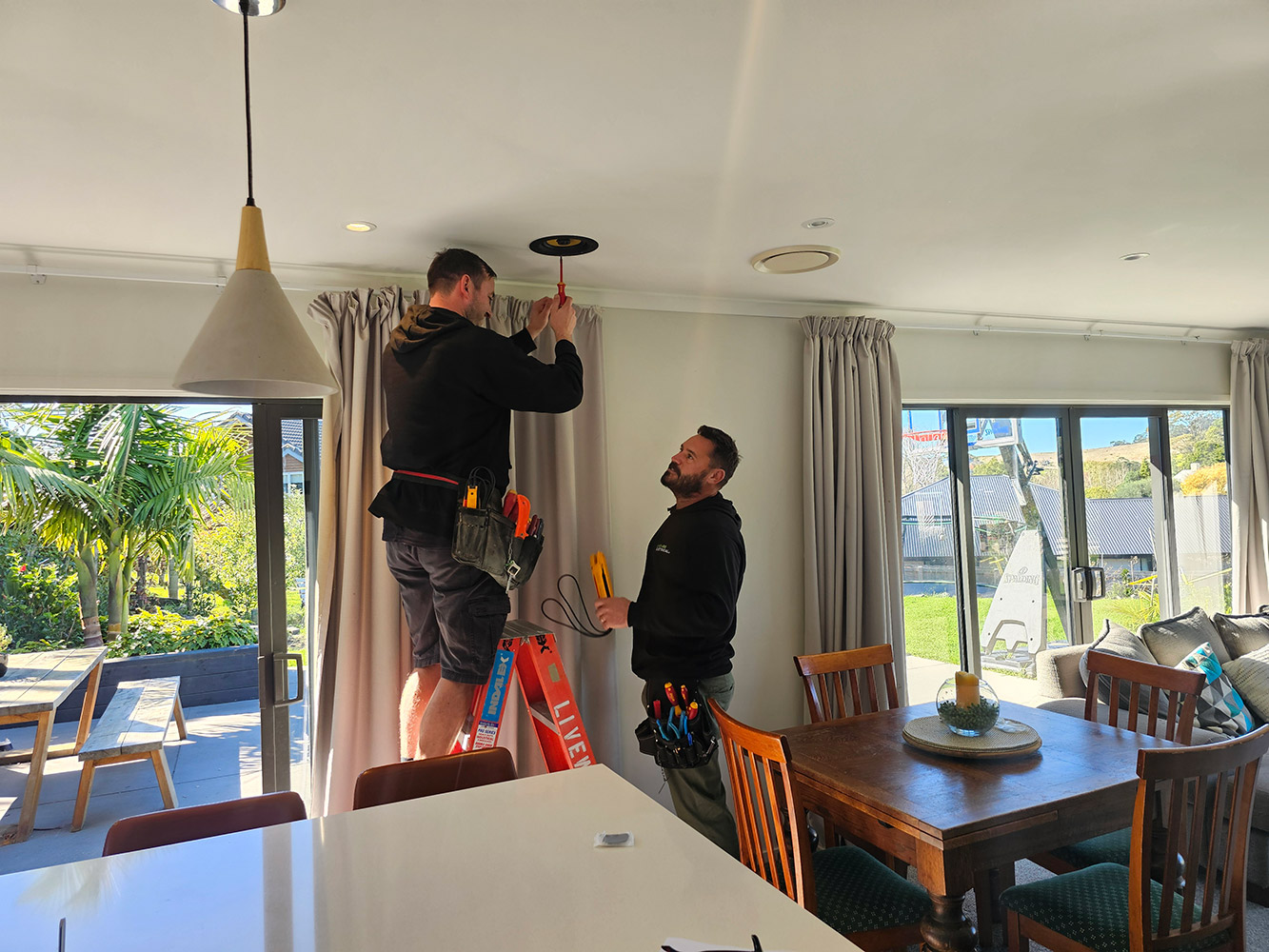
Registered electricians based in Kumeū, trading since 2013, rated 4.9 on Google. Lead electrician licence E262038.
Fixed and itemised
Your builder can see exactly what is in the price and what is not.
Booked around your trades
Prewire lands before lining and waterproofing, fit-off after tiling and paint.
Certified and tested
Every circuit is tested and you get the compliance paperwork for your records.









FAQs
Got questions? We've answered the most common ones here.
Which parts of Auckland does Livewire do bathroom electrical in?
Livewire is based in Kumeū and works across North West Auckland (Kumeū, Huapai, Riverhead, Waimauku, Whenuapai, Hobsonville), West Auckland (Henderson, Te Atatū), the North Shore (Birkenhead, Takapuna, Northcote Point, Orewa, Whangaparāoa) and central Auckland (Parnell, Remuera, Epsom, Ponsonby, Mount Eden and surrounds).
What warranty does Livewire give on bathroom electrical work?
Livewire gives a lifetime workmanship warranty on its electrical work. Fittings and appliances you supply carry the manufacturer's warranty.
What is the difference between a Certificate of Compliance and an Electrical Safety Certificate?
A Certificate of Compliance covers the lawfulness and safety of prescribed electrical work as it is done, and an Electrical Safety Certificate confirms an installation or part of one is electrically safe once it is connected to supply. A bathroom renovation can involve both. Livewire issues the compliance paperwork after the circuits are energised and tested.
Is my switchboard good enough for a new bathroom?
Not always, especially in older Auckland villas and bungalows. New circuits and a heater add load, and an old board may lack spare capacity or modern shock protection. A licensed electrician checks the board at the quote stage. If it needs upgrading, doing it during the renovation is cheaper than doing it separately later. Livewire's renovation packages assume the existing board has capacity, so an upgrade is quoted separately.
Can my plumber, builder or I do the bathroom electrical work?
Generally no. Most fixed wiring in a bathroom is prescribed electrical work that must be done by a licensed electrical worker, and a plumber, tiler or builder is not licensed to do it. Homeowners may do only limited work under strict conditions, and landlords cannot do fixed wiring in a rental at all. See WorkSafe's guidance on getting electrical work done.
What paperwork does an electrician give you after a bathroom renovation?
A licensed electrician issues the electrical compliance paperwork for the work, which in NZ means a Certificate of Compliance for prescribed electrical work and an Electrical Safety Certificate when the work is connected to supply. Keep it with your house records. Insurers, buyers' lawyers and your builder may ask for it later.
How is a backlit or demist mirror wired?
A backlit or demist mirror needs a power feed behind or beside it, run at prewire stage while the wall is open. The feed position depends on the mirror model, so send the model number. Livewire prices the mirror connection as an upgrade.
Can bathroom lights be dimmed?
Yes, if the LED lights and the dimmer are compatible and rated for the location. Livewire's standard package includes a 3 gang switch, so ask for dimming to be priced at the quote stage. A vanity night light sensor is available as an upgrade.
What colour temperature should bathroom lights be?
Two common choices are 3000K (warm white) for a relaxed feel and 4000K (neutral white) for clearer light at the mirror. Use the same colour temperature for every light in the room so the light looks even. A dimmable option and a night light sensor suit late-night use.
What should I plan for mirrors, LED strips and night lights?
Plan the power for them before the lining goes on. A demist or backlit mirror needs a feed behind it, and a vanity LED strip or night light sensor needs cable run to the vanity. Livewire prices each as an upgrade, and each is far cheaper at prewire stage than afterwards.
What lights suit a bathroom, and can I supply my own vanity light?
Bathroom lights must be rated for the moisture they will see, and fittings closer to the shower need a higher protection rating. You can supply your own vanity wall light, and Livewire installs it. Send the model before prewire so the electrician can check it suits its position.
What controller does underfloor heating need?
It needs a controller with a floor temperature sensor, and many controllers also offer a schedule or app control. The electrician fits the controller and wires it to a dedicated circuit, and the heating wires are laid by others. Choose the controller before prewire so the cable and sensor positions are right.
Is underfloor heating worth it in a bathroom?
For a tiled bathroom in Auckland, yes, if the budget allows. It warms the floor where your feet are, keeps tiles dry and works quietly with a timer and floor sensor. It must be decided before tiling, because the heating wires go under the tiles.
Can a heated towel rail run on a timer?
Yes, a timer or smart plug keeps the rail from running all day. Running cost depends on the rail's wattage and the hours it is on, so compare the wattage when you choose a rail. Tell the electrician at quote stage if you want a timer wired in.
Is a heated towel rail enough to heat a bathroom?
No. A heated towel rail dries towels and takes the chill off, but its output is low and it does not warm the room. Use it with a wall heater or underfloor heating if you want a warm bathroom.
Should a heated towel rail have exposed or concealed wiring?
An exposed cord plugs into a power outlet beside the rail and is cheapest, while concealed wiring runs inside the wall to a remote transformer and leaves nothing visible. Concealed is tidier and more expensive, and it has to be decided before the lining goes on. Livewire's from-price includes the exposed cord set-up and prices concealed wiring as an upgrade.
Does underfloor heating need its own circuit?
Yes, underfloor heating normally needs a dedicated circuit with its own controller. The heating wires or mats are laid by the tiler or a heating installer, and the electrician runs the circuit, fits the controller and tests everything before and after the floor is covered. Livewire prices the dedicated circuit and controller as an upgrade, with the heating wires installed by others.
What is the best way to heat a bathroom?
A wall heater warms the room fastest, underfloor heating gives the most comfortable floor, and a heated towel rail dries towels but barely heats the room. Many Auckland renovations combine a heater on a timer or switch with a towel rail, and add underfloor heating when the budget allows. Underfloor heating must be decided before tiling because it goes under the tiles.
Are inline extract fans quiet?
Inline fans are usually quieter than ceiling-mounted fans because the motor sits in the roof space, away from the room. Only a small grille shows in the ceiling. Duct length, bends and the fan model still affect noise.
Can a bathroom fan run on a timer or humidity sensor?
Yes, a run-on timer or humidity sensor keeps the fan going after the shower and clears the steam that causes mould. Decide before prewire because the control may need extra wiring. Livewire's standard 3 gang switch operates the fan manually, so ask for a timer or humidity control to be priced.
How big an extract fan does a bathroom need?
The right fan depends on the room volume and the length and bends of the duct. A long or bent duct reduces airflow, so check the fan's rated extraction at your duct length, not its headline figure. Livewire's package uses a 150 mm inline fan with up to 6 m of duct to the soffit.
What is an inline extract fan?
An inline fan has its motor mounted in the roof space, joined by ducting to a small grille in the bathroom ceiling. Because the motor sits away from the room it is quieter than a ceiling-mounted fan, and the 150 mm duct moves air more effectively over longer runs. It needs enough ceiling access to fit the motor and run the duct.
Where should a bathroom extract fan vent to?
A bathroom fan should vent to the outside, usually through a duct to the soffit or roof, never into the roof space. Warm, wet air released into the roof space condenses on cold timber and insulation and leads to mould and rot. Livewire's package ducts the inline fan to the soffit with a weatherproof grille, up to 6 m of duct.
Does a bathroom need an extract fan?
In Auckland's humid climate a ducted extract fan is the reliable way to keep a bathroom dry and mould-free. Bathrooms must be ventilated, and a window alone often is not enough, especially for an internal or shower-heavy room. Ask your designer or builder what your plans require. Livewire's package includes a 150 mm inline fan.
Do I need a power point for a smart toilet or bidet seat?
Yes, a smart toilet or bidet seat needs an outlet within reach of the toilet, positioned where the wiring rules allow. Plan it before the lining goes on, with the model number, because outlet position depends on the product. Adding it after tiling usually means cutting into finished walls.
Can you have a power point in a bathroom, and what about shaver or USB outlets?
Yes, a bathroom can have power points in permitted positions with shock protection. Livewire's package includes a double horizontal vanity power point on its own RCBO. A shaver socket or USB outlet at the vanity can be added, so ask for it to be priced before prewire.
What IP rating do bathroom lights need?
The IP rating needed depends on the zone the fitting sits in, with higher ratings closer to the water. The electrician specifies the rating for each light once the layout is known. Check the IP rating of any vanity wall light you supply before buying it.
Can you put downlights in a shower?
Only downlights rated for that location, and the electrician has to check the rating against the zone. A standard downlight is not suitable above a shower. Tell the electrician where the shower sits so they specify moisture-rated fittings.
What are bathroom electrical zones in NZ?
Bathroom zones are the areas around the bath, shower and basin where the wiring rules restrict which fittings and wiring can be used, based on how likely they are to get wet. The closer a fitting is to the water, the higher the moisture protection it needs. A licensed electrician applies the zone rules to your layout, so send them the plan before prewire.
How do I choose an electrician for a bathroom renovation?
Check their licence number, ask for an itemised fixed quote with exclusions listed, and confirm the paperwork and warranty you will receive. Also ask whether they have wired bathrooms in houses like yours, and how they fit around your plumber and tiler. Livewire's lead electrician holds licence E262038, and every quote is itemised in writing.
What happens if the electrician finds a problem when the walls are open?
The electrician tells you what was found, explains the options and quotes any extra work before doing it. Opened walls sometimes show damaged cable, poor joints or overloaded circuits. Anything unsafe has to be fixed before the work can be certified.
Can my existing bathroom wiring be reused?
Sometimes. Livewire's package reuses or relocates the existing bathroom lighting supply cable and connects the new vanity power point to the existing power circuit. The electrician checks the condition and capacity of that wiring at the quote stage, and damaged cable is replaced where it is found.
Does the electrician come before or after the plumber and waterproofer?
The electrician does prewire before the lining and waterproofing go on, and fit-off after tiling and paint. Tell the waterproofer where every cable and duct goes through the lining, so each penetration is dealt with before the membrane is applied. Book the electrician as soon as the layout is fixed.
What is the difference between prewire and fit-off?
Prewire is running the cables and fan duct while the walls and ceiling are open, and fit-off is installing the switches, lights, fan, heater and power points once tiling and paint are done. They are two visits because cables must be in before the lining and waterproofing go on. Livewire typically needs 1 to 2 days for prewire and half a day to 1 day for fit-off.
What electrical work does a bathroom renovation need?
A bathroom renovation typically needs lighting, an extract fan ducted outside, a heater, power for the vanity and towel rail, optional underfloor heating, and certification of the finished work. New cables and the fan duct go in while the walls are open (prewire), then switches, lights, the fan, heater and outlets are connected after tiling and paint (fit-off). Livewire's standard package covers all of it for a single bathroom.
Can the electrician still wire my bathroom if the walls are already lined?
Yes, but it costs more and creates repair work. The electrician has to open the lining, run cable through the framing and leave the lining and tiles to be patched, which is why the from-price assumes the linings are already off. If your bathroom is still open, book your electrician now.
What should I decide before the electrician starts prewire?
Decide the vanity position and mirror type, the shower and towel rail locations, where the heater goes, whether you want underfloor heating, and whether the towel rail wiring is exposed or concealed. Each of these fixes where cable runs behind the lining, and changing any of them after tiling means breaking tiles. Send the electrician your layout and the model numbers of everything you are supplying.
How long does bathroom electrical work take?
Prewire typically takes one to two days and fit-off half a day to one day for a standard bathroom. Prewire is the more time-consuming visit because every cable run and the fan duct go in while the framing is open. A stripped-back bathroom with a clear ceiling space is the fastest to wire.
When does the electrician come during a bathroom renovation?
An electrician comes twice: once for prewire and once for fit-off. Prewire happens after demolition and before the wall and ceiling linings and waterproofing go on, while the framing is open. Fit-off happens after tiling, the vanity and paint, when switches, lights, the fan, heater and power points are installed and tested.
Are bathroom electrical prices in NZ quoted with or without GST?
Many NZ electricians quote without GST, so always ask. Livewire's bathroom package is $3,500 + GST, which is $4,025 including 15% GST. The quote is fixed and itemised, so the figure you approve is the figure you pay unless you change the scope.
What can push a bathroom electrical quote above the starting price?
The main factors are a fan duct longer than 6 m, a second storey or limited ceiling access, and upgrades such as underfloor heating, a demist mirror, LED strip lighting or concealed towel rail wiring. Linings that are already back on also add cost because the walls must be opened to run cable. The package assumes the existing switchboard has capacity for the new circuits, so a switchboard upgrade is outside it and quoted separately. Livewire itemises each of these in a fixed quote before work starts.
What is included in the from-$3,500 + GST bathroom package?
The package covers disconnection of the old fittings, prewiring, fit-off and certification. That includes two LED downlights, a vanity wall light connection, a 150 mm inline extract fan ducted to the soffit, a double vanity power point, a towel rail outlet on an exposed cord, a wall heater, and a 3 gang switch with its own RCBO. Every circuit is energised, tested and certified.
How much does an electrician cost for a bathroom renovation in NZ?
Bathroom renovation electrical from Livewire Electrical starts from $3,500 + GST ($4,025 incl. GST) for a standard single bathroom with the linings already removed. The final figure depends on the number of fittings, whether the fan duct is straightforward, any underfloor heating, and the condition of the switchboard.
Related services
Explore other services we provide across Auckland.
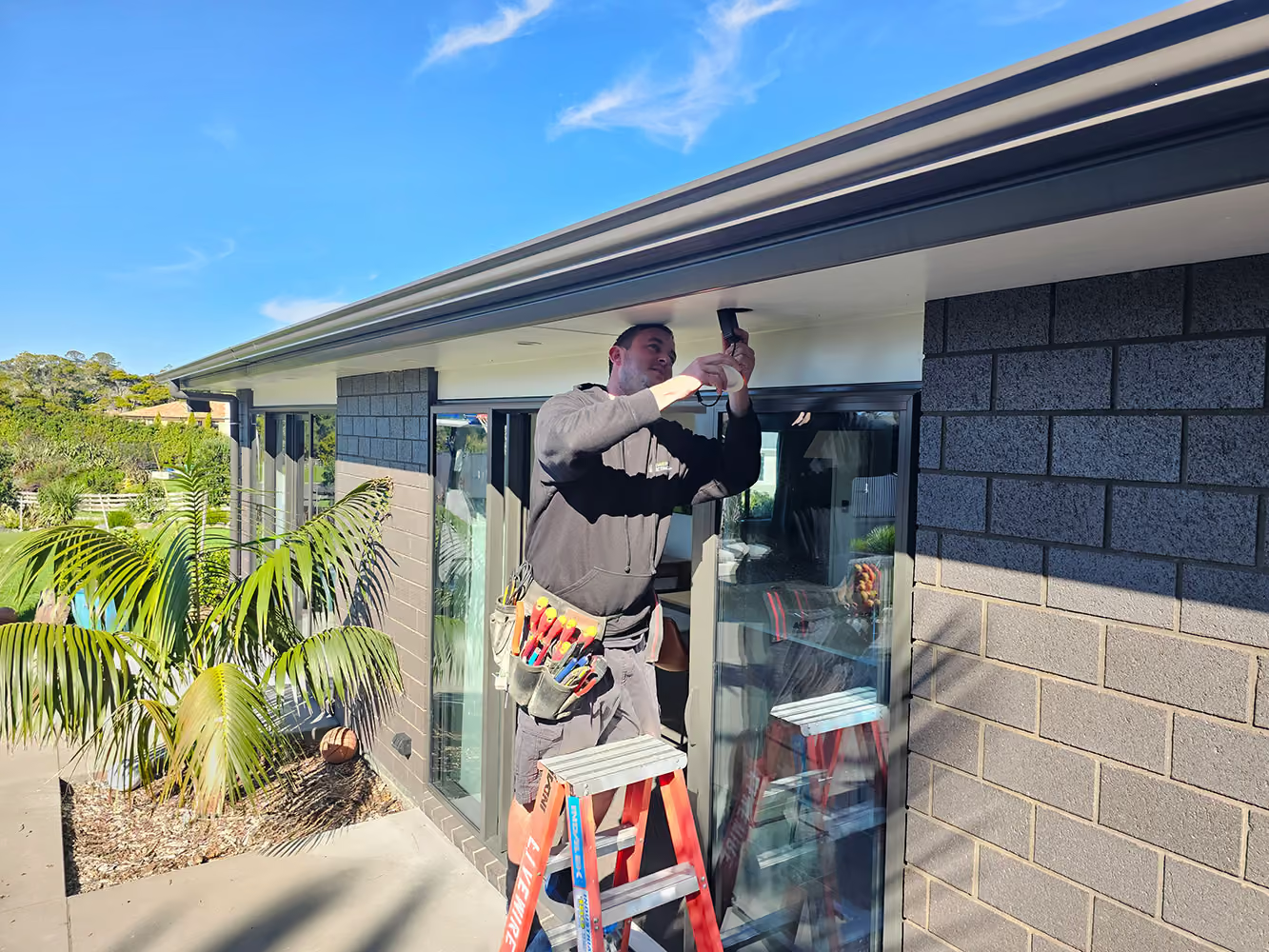
Based in Kumeū, working across Auckland
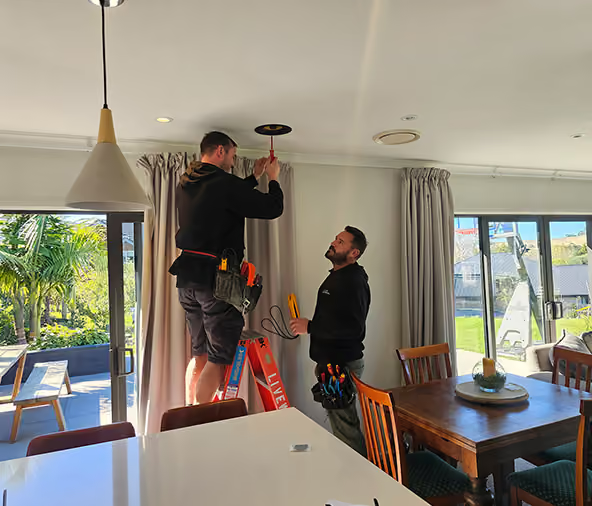
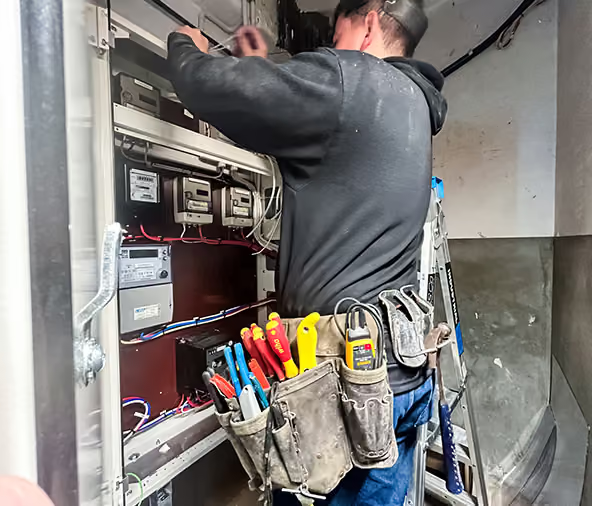
Fastest response across Huapai, Riverhead, Waimauku, Whenuapai and Hobsonville. Auckland-wide for rewires, switchboards, EV chargers and commercial work.


Get a fixed quote
Tell us about the job. You get an itemised price before any work starts, and we reply within one business day.