

A home electrical system is the chain that brings power from the street network to your lights and sockets. In New Zealand it runs from the service line to the meter box, then the main switchboard, where circuit breakers and RCDs protect each circuit, then out through the wiring to every power point, switch and fixed appliance.
Most of the "how your house electrics work" guides online are American. They talk about breaker panels, 120 volts and white neutral wires, which will only confuse you here. This is how it works in a Kiwi home, in the order the power travels.
1. The network and your service line
Power reaches your street on the lines company's network. Across most of Auckland that company is Vector. Your power retailer, the company that sends the bill, is a separate business.
From the street, a service line runs to your property, either overhead from a pole or underground from a pillar box near the boundary. Most homes are supplied at 230 volts, single phase. The supply is protected by a service fuse at the pole or pillar. Larger homes, and some with big heat pumps or EV chargers, have a three-phase supply.
Who looks after the service line can be confusing. As a rule, the network company owns the street side and the cable on your property is your responsibility, but arrangements vary, so check with Vector or an electrician if a service line is damaged.
2. The meter box
The meter box is usually on an outside wall. It holds:
- The meter, which records how much power you use. Most Auckland homes now have a smart meter that sends readings automatically. The meter belongs to a metering company, not to you.
- Often a ripple relay or a separate meter for the hot water cylinder, which lets the network switch your cylinder off during peak demand in exchange for a cheaper rate.
- In many homes, the main switchboard as well. Older houses often have the meter and the fuses in the same outside box.
3. The main switchboard
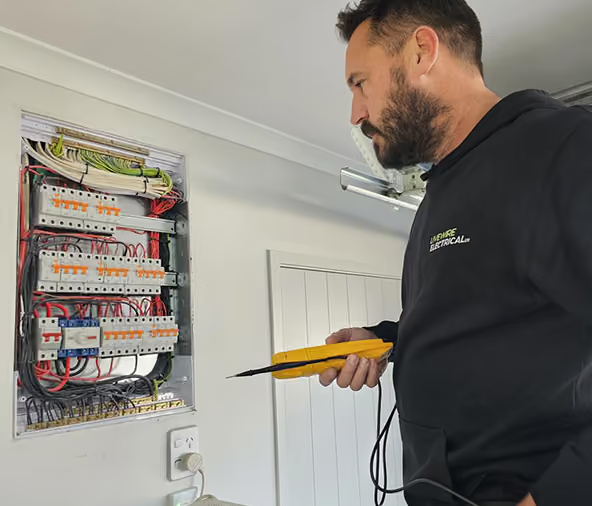
The switchboard is the heart of the system. Americans call it the electrical panel or breaker box, and some Kiwis call it the fuse box or power box. It can be outside with the meter, in the garage, or in a hallway cupboard.
Inside you will find:
- The main switch, which turns off power to the whole house.
- Circuit breakers or fuses, one for each circuit. Older homes have ceramic rewireable fuses with fuse wire. Newer boards have breakers that you reset by flicking them back on.
- RCDs (residual current devices), which cut power within a fraction of a second if current leaks to earth, for example through a person. They have a "Test" button.
- The earth bar and neutral bar, linked together under New Zealand's MEN earthing system and connected to an earth electrode in the ground outside. We explain this in our guide to electrical earthing.
Circuit breaker or RCD: what's the difference?
A circuit breaker protects the wiring. It trips when too much current flows, such as an overload or a short circuit, so the cable does not overheat. An RCD protects people. It trips when a small amount of current goes where it should not. Many modern boards use combined devices, called RCBOs, that do both jobs for one circuit.
4. Circuits
Your house is split into separate circuits, each fed from its own breaker or fuse. A typical New Zealand home has:
- Lighting circuits, often one or two per area of the house.
- Power circuits feeding the general sockets.
- Dedicated circuits for the oven or cooktop, the hot water cylinder, heat pumps, and sometimes a spa, workshop or EV charger.
Splitting the load this way means a fault on one circuit only knocks out that part of the house. It is also why your lights might stay on when the kitchen sockets trip.
5. Wiring, switches and power points
Cables run inside the walls and ceiling from the switchboard to every outlet. Modern New Zealand homes use TPS (tough plastic sheathed) cable. Older homes may still have rubber-insulated cable, which goes brittle and cracks with age.
Wire colours have changed over the years:
- Active (live): red in older wiring, brown in current wiring.
- Neutral: black in older wiring, blue in current wiring.
- Earth: green in older wiring, green/yellow in current wiring.
New Zealand power points take the three-pin plug shared with Australia, and almost all of them have their own switch.
How many amps does a house get in NZ?
Most single-phase homes in New Zealand have a supply of around 60 to 63 amps. Vector's standard residential connection in Auckland is 60 amps single phase. That is plenty for an ordinary household, but it can get tight if you add an EV charger, several heat pumps and an induction cooktop. An electrician can work out your load and tell you whether you need a bigger supply or three-phase power.
Signs your home electrical system needs attention
- Ceramic fuses with fuse wire on the switchboard, or no RCDs anywhere.
- Breakers that trip often, especially when two appliances run at once.
- Lights that flicker or dim when something big turns on. Our guide to flickering lights covers when that is normal and when it is not.
- Warm or scorched sockets and switches, a burning smell, or buzzing from the switchboard.
- Not enough sockets, so power boards and extension cords have become permanent.
- Rubber-insulated or cloth-covered cable in the roof space of an older villa or bungalow.
An old switchboard with rewireable fuses and no RCD protection is usually the first thing to fix, and a switchboard upgrade brings in modern breakers and RCDs in one job. If the cable itself is perished, the fix is rewiring the affected circuits.
What you can do yourself
You can reset a tripped breaker, replace fuse wire in an old ceramic fuse with the correct rating, and press the RCD test button every few months. Find your main switch now, so you are not hunting for it in an emergency.
Wiring is another matter. In New Zealand, work on fixed wiring is prescribed electrical work for licensed electricians. There is a limited exemption for owner-occupiers under the Electricity (Safety) Regulations 2010 (regulation 57), but it excludes switchboard work, and any wiring done under it must be tested and connected by a licensed inspector. WorkSafe's advice is to use a licensed electrician if you are in any doubt.
When to call an electrician
- A breaker trips repeatedly or will not reset.
- You notice heat, scorching, buzzing or a burning smell at a socket, switch or the switchboard.
- Your switchboard still has rewireable fuses or no RCDs.
- You are planning an EV charger, heat pumps or a renovation and want to know if your system can cope.
- You are buying an older home and want the electrics checked.
Livewire's registered electricians look after homes across West, North and Central Auckland. We can check your system and tell you plainly what needs doing now and what can wait.
Frequently asked questions
What is a home electrical system?
It is everything that carries power from the street to your appliances: the service line, meter box, main switchboard, circuit breakers and RCDs, the wiring inside your walls, and the switches and power points at the end of each circuit.
What is the electrical system in a house called?
The whole setup is usually called the electrical installation. The central part, where the circuits are protected, is the switchboard in New Zealand, the electrical panel or breaker box in the US, and the consumer unit in the UK.
What is the power box in a house called?
In New Zealand it is the switchboard, sometimes called the fuse box. The box holding the power meter outside is the meter box, and in many older homes the two are combined.
What type of wiring is used in most NZ homes?
Modern homes use TPS (tough plastic sheathed) cable with brown, blue and green/yellow conductors. Older homes may have red, black and green conductors, and some very old homes still have rubber-insulated cable that should be checked.
Is 60 amps enough for a house?
For most New Zealand homes, yes. It can get tight with an EV charger, several heat pumps and electric cooking running together. An electrician can do a load calculation and advise whether you need a supply upgrade.
Do I need an electrician to change a fuse box?
Yes. Switchboard work is excluded from the homeowner exemption, so replacing or altering a switchboard must be done by a licensed electrician and certified.